
في هذا المقال
 Strategic Planning and Achieving Competitive Advantage in the Modern Business Environment
Part 1: Theoretical Framework and Core Concepts
. Introduction
In today’s highly dynamic business environment, competition is no longer determined solely by product quality or resource availability. Instead, it is increasingly shaped by an organization’s ability to anticipate the future, formulate strategic directions, and align internal capabilities with external market dynamics.
Modern organizations operate in environments characterized by volatility, uncertainty, complexity, and ambiguity (VUCA). In such conditions, strategic planning becomes not just a managerial function but a survival mechanism.
Organizations that successfully implement strategic planning are more likely to:
Adapt to market changes effectively
Optimize resource utilization
Strengthen long-term positioning
Build sustainable competitive advantage
Conversely, organizations lacking strategic clarity often experience declining performance despite having sufficient operational capabilities.
A typical example can be observed in mid-sized manufacturing firms operating in highly competitive markets. Although such firms may maintain acceptable product quality and operational consistency, they often face gradual market share decline due to weak strategic alignment between long-term objectives and daily operational decisions.
This gap between strategy and execution highlights the critical importance of strategic planning as a bridge between vision and operational reality.
1- Definition of Strategic Planning
Strategic planning can be defined as:
“A systematic managerial process used to define an organization’s long-term direction, formulate objectives, analyze internal and external environments, and allocate resources to achieve sustainable organizational performance.”
This definition emphasizes four core dimensions:
Direction setting (vision and mission)
Environmental analysis
Objective formulation
Resource allocation and execution
According to Robbins & Coulter (Management Theory), strategic planning represents the foundation of all managerial functions, as it determines the organization’s.direction and priorities
Core Strategic Questions.1-2
Strategic planning is built upon three fundamental questions:
| Strategic Meaning | Question |
| Current position analysis | Where are we now? |
| Future strategic objectives | Where do we want to be? |
| Implementation roadmap | How do we get there? |
These questions form a logical decision-making framework that transforms abstract vision into actionable strategies.
Components of Strategic Planning 2 -
Vision Statement
The vision represents the desired future position of the organization. It serves as a long-term inspirational direction.
Example:
“To become a regional leader in innovative textile manufacturing within five years.”
A strong vision:
Aligns organizational efforts
Enhances employee motivation
Supports strategic consistency
Mission Statement
The mission defines the organization’s purpose and core activities.
Example:
“To deliver high-quality textile products that meet customer needs through innovation and operational excellence.”
The mission answers:
What do we do?
For whom do we do it?
How do we deliver value?
Strategic Objectives (SMART Model) -3
Strategic objectives must follow the SMART criteria:
Specific
Measurable
Achievable
Relevant
Time-bound
Performance Measurement Formula
�
Example
If a company sets a sales target of 1,000,000 USD and achieves 850,000 USD:
�
This indicates a performance achievement level of 85%, which reflects partial success with room for improvement.
Environmental Analysis (SWOT Framework) 4-
One of the most widely used tools in strategic planning is SWOT analysis:
| External Environment | Internal Environment |
Opportunities | Strengths |
Threats | Weaknesses |
Strategic Implications
Strengths → leverage competitive advantage
Weaknesses → areas for improvement
Opportunities → growth potential
Threats → risk mitigation
Efficiency and Resource Utilization5-
Strategic planning improves organizational efficiency by optimizing resource allocation.
Efficiency Formula
Higher efficiency indicates better utilization of resources such as labor, capital, and technology.
Strategic Planning Importance6-
Ensures that financial and human resources are directed toward high-impact activities.
Risk Reduction
Scenario planning enables organizations to prepare for uncertainties and reduce operational risks.
Organizational Alignment 7-
Strategic planning aligns all departments under unified objectives, reducing internal conflict and inefficiency.
Foundation of Competitive Advantage
Strategic planning is directly linked to competitive positioning, as it enables organizations to:
Identify market gaps
Develop differentiation strategies
Improve long-term sustainability
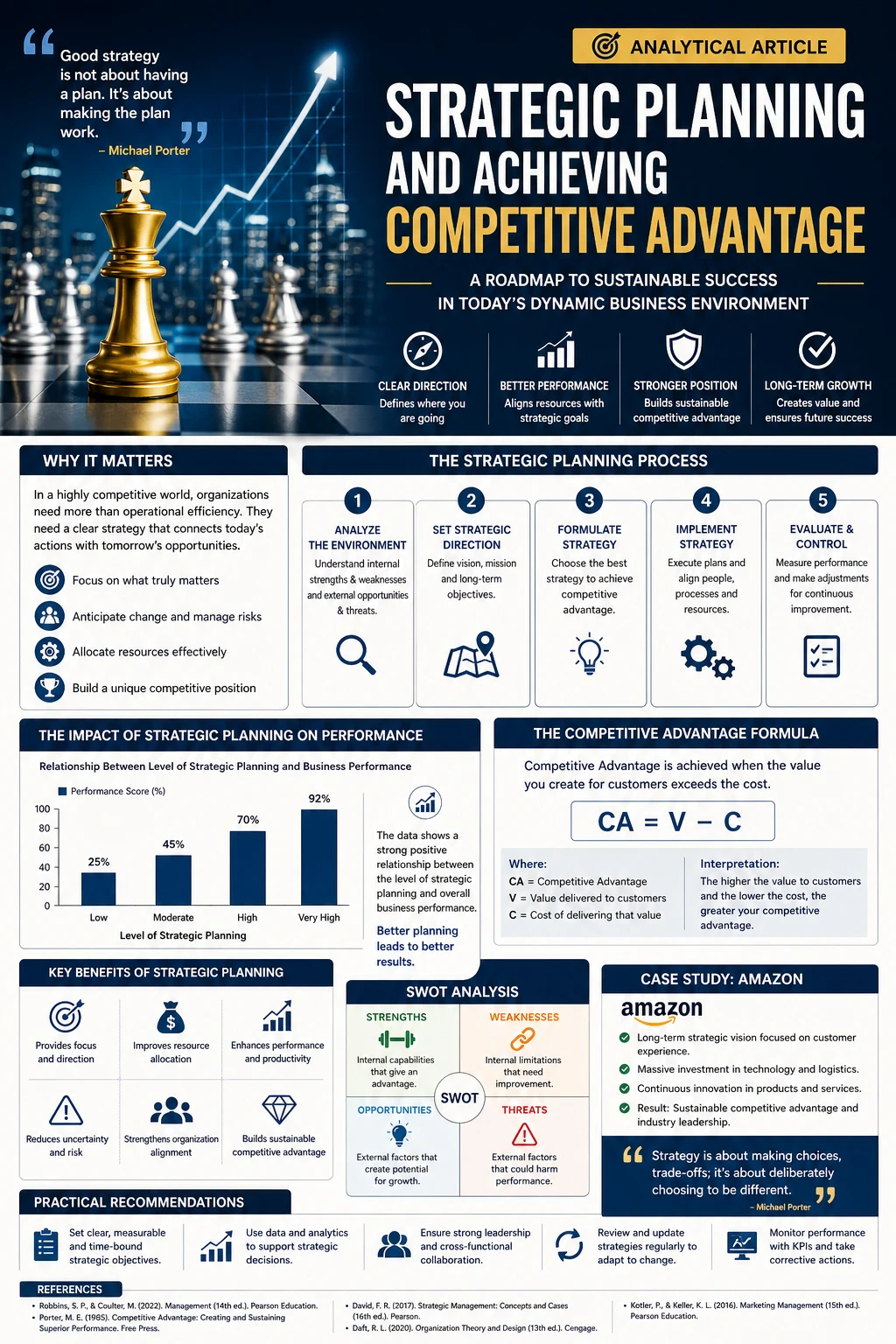
Conceptual Strategic Flow Model 8-
A simplified strategic process can be illustrated as:
Environmental Analysis
↓
Vision & Mission
↓
Strategic Objectives
↓
Strategy Formulation
↓
Implementation
↓
Performance Evaluation
Preliminary Academic Insight 8 -
Research in strategic management consistently shows that organizations with formal strategic planning systems outperform those without structured planning processes. Studies in Harvard Business Review and Strategic Management Journal highlight a strong correlation between strategic clarity and long-term profitability.
Next Step (Part 2 will include):
Strategic planning vs competitive advantage (deep analysis)
Porter’s Generic Strategies
Value Chain Analysis
Statistical models + performance graphs
Real business case application
References
Porter, M.E. (1985). Competitive Advantage: Creating and Sustaining Superior Performance. New York: Free Press.
Robbins, S.P. & Coulter, M. (2018). Management. Pearson Education.
Bryson, J.M. (2011). Strategic Planning for Public and Nonprofit Organizations. Wiley.
Johnson, G., Scholes, K. & Whittington, R. (2017). Exploring Strategy. Pearson.
Kaplan, R.S. & Norton, D.P. (1996). The Balanced Scorecard. Harvard Business School Press.
Barney, J.B. (1991). “Firm Resources and Sustained Competitive Advantage”, Journal of Management, 17(1), pp. 99–120.
Before Part 2
This article represents the first part of a broader analytical study on strategic planning and competitive advantage. While this section has introduced the fundamental concepts, theoretical foundations, and key analytical tools, it is important to emphasize that these elements form only the basis of a deeper strategic discussion.
The next part of this study will move beyond the introductory framework and will focus on a more advanced level of analysis, including the relationship between strategic planning and competitive advantage, real-world applications, strategic models, and practical business case evaluations supported by data-driven insights.
تابع جديد Yasi Abo
اختر إشعارات الموقع أو البريد أو الاثنين. الزائر يقدر يشترك ببريده دون تسجيل حساب.
الإبلاغ عن المقال
لو لاحظت مشكلة في المحتوى، أرسلها لفريق المراجعة. لن تظهر بياناتك لكاتب المقال أو للقراء.
تعذّر إرسال البلاغ الآن. حاول مرة أخرى لاحقًا.
سجّل الدخول لإرسال بلاغ








النقاش
التعليقات (0)
فكرة تضيفها، أو سؤال يفتح حوارًا.
الرجاء تسجيل الدخول لتتمكن من التعليق